
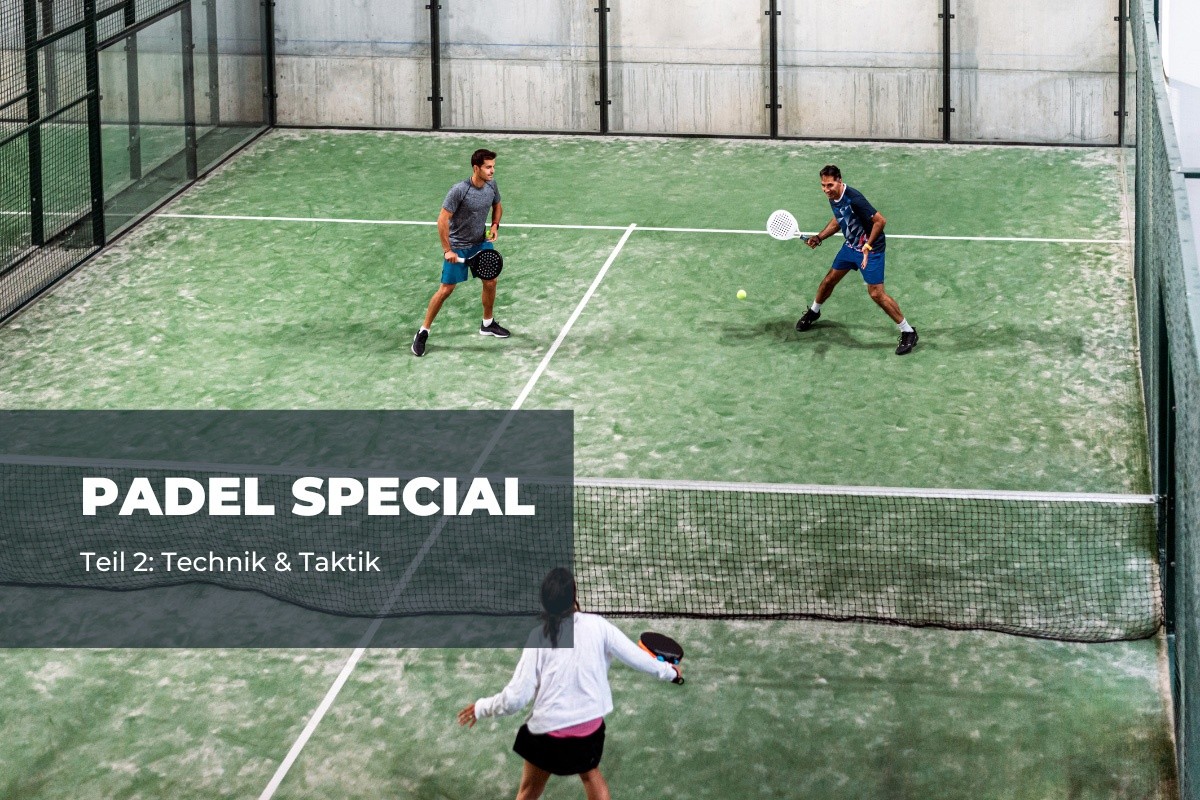
In part two of our padel special, we're focusing on stroke technique and tactics. For those who don't yet know what a Salida, Contra Pared, x3, or Bandeja is, our padel expert Yannik Mann shed some light on the subject. From the serve to groundstrokes, the lob, drop shot, or overhead smash – for all the different padel strokes and variations, we have a short video alongside the explanation. This way, you can see how each stroke works and is played. And for the padel expertsamong you – or those who aspire to be – Yannik has an absolutely invaluable tactical tip. It's not just about brute force; smart padel is key. And that's quite different from tennis in many ways. That's why it's so important to approach the game correctly, both technically and tactically.
Enjoy our second part! After this, everyone should know that a Chiquita in the context of paddling doesn't refer to a banana!
Most people start playing padel. That's what quickly captivates so many players – competition with friends in no time. The rules from the first part of our padel special are enough to start a match. Now we're going a few steps further. Padel strokes and tactical tips await you in the second part of our padel special.
Similar to tennis, there are two serves, and the service side alternates after each point. The ball must bounce behind the service line and be struck below hip height. It is then played into the diagonally opposite service box. There, the ball may touch the glass after bouncing, but not the railing. If the ball hits the net, the serve is repeated. To make the serve difficult for the opponent, we try to play a slice serve, keeping the ball low.
Play the ball as close to the service line as possible. This way, the ball travels further, giving you time to get into position at the net. If you're not quick on your feet, you shouldn't serve too fast either, otherwise you won't be in position when your opponent hits the ball.
The primary tactical objective is to gain or maintain the net position. Most points in padel are won at the net. Take advantage of your opportunities to run to the net with your partner. The easiest way to reach the net is after a good lob (beginner level). More advanced players also often try to take the net position after a shot that lands at the opponent's feet (chiquita).
The ball must bounce once in the service box before it can be played. You can choose your position freely. However, it's advisable to stand behind the service line and slightly closer to the side wall than in the middle when returning the ball.
The ball that hits the first disc from the side can be played towards the wall. If it only hits the second disc from the side, you must try to play the ball after it bounces on the floor.
In beginner-level returns, the primary goal is to force your opponent into another shot. At this level, the opponent should aim to win all the points at the net – for themselves and for you. If your opponent receives an easy ball from you and responds with a winner, congratulations! I'd rather let my opponent win the point than make a mistake myself. There's a big difference between "my opponent wins the point" and "I lose the point.".
If you're playing down the line from a defensive position, your opponent will most likely switch to your partner to apply pressure, allowing you to return to your original position. Should the ball come back to you from your down-the-line opponent, you have the following advantages:
Direct groundstrokes are all strokes played after the bounce without contact with the boards.
If you hit the ball below the net while in a defensive position, try to prepare with your hand below the point of contact so that your movement towards the ball automatically goes from bottom to top. This will ensure you get the ball over the net, and it won't rise as high as if you were playing a slice at the same speed below the net.
Once the ball reaches you above the net, you can prepare above it and play backspin.
Low shots – with the point of contact below net height – are called "salida de pared" in Spanish. If the ball first touches the ground, it always has backspin after contacting the back wall. To transfer this backspin, we open the clubface in preparation for the "salida de pared." This allows the ball to fall onto the clubface after hitting the back wall.
The ball, which bounces high off the back wall, is prepared with the hand above the meeting point and is called Bajada de pared.
Generally, it's important, especially for tennis players, to view the back wall as an ally , helping to slow down the game and give your opponent more time on defense. Try letting balls that bounce behind the service line pass through. In match situations, you'll usually revert to what you already know, but the sooner you start letting the balls pass, the faster you'll improve defensively.
The contra pared is a shot off the cushion. Both the back and side walls can be used to hit the ball back to the other side. "Side and back walls" refers only to the glass structure. The mesh must not be hit directly.
Beginners, please note: Only use this shot after you have practiced it a few times with a coach.
The cushion should primarily be used when the ball doesn't rebound far enough after hitting the wall to allow for a backcourt shot. This is especially true when:
Every tennis player knows volleys, and most play them well. In padel, the classic tennis volley is primarily played in volley-to-volley matches. Due to the short distance to the opponent, there is hardly any time to prepare the shot; therefore, shots must be taken quickly and behind the point of contact.
If your opponent is in a defensive position, it makes sense to play the ball with a bit more backspin to create a low bounce off the back wall. For this to work, your opponent's ball should arrive above net height, and your hand should be raised to at least the height of the point of contact. The striking motion then goes from back and up to front and down.
Play high volleys (above net height) quickly, either to your opponent's feet or in front of the goal line if you're aiming for an opening. If you play into an opening and the ball goes too far back, it will bounce far away from the disc and become easier for your opponent to return. Playing in front of the goal line means the ball will hit the disc as it falls, making it difficult to return.
Try to build up the point together with your partner through the middle. Only after the opponent has been forced into the middle will you have space on the outside. Play together against the person who just played the ball in the middle, staying in the middle position – the outside will be against one of you.
The lob is one of the most important shots in padel. When do you play a lob? When I need time because my opponent has hit a good ball that's hard to reach?
The answer is: NO, that's tennis. In padel, it's exactly the opposite. The lob in padel is an offensive shot because we achieve our primary tactical goal, the net position, with a good lob. If we play the lob too low, too short, or too long, we invite our opponent to hit us. For a good lob, we need an easy ball. As soon as you start playing with the backboard, I advise you to play lobs towards the back wall. After the back wall, the ball is already heading in the right direction, and you just need to add a little height and direction.
Play difficult balls flat and easy balls as lobs.
In padel, drop shots are also used to surprise the opponent and make them chase the ball. Sure, a drop shot out of the door looks nice, but how often does it work? Beautiful isn't always effective, and a drop shot isn't always a winner. A short ball down the middle of the court is often enough to force communication problems from the opponent and break up their game. Unlike tennis, in padel, drop shots aren't played from a defensive position, as the opponents are in an offensive position at the net.
If your opponent plays a Chiquita and can't advance, play a drop shot. The ball is relatively slow and arrives below net height. With a little backspin, it becomes a dream shot.
Chiquita, Spanish for "little girl," is the name given to a shot played at the opponent's feet. This forces the opponent to play the ball below net height and lift it. If the Chiquita is well executed, it also gives the player a chance to get into a net position.
The smash is familiar to every tennis player and isn't a problem even with a smaller racket. Many incorrect decisions are made at the beginning because the ball is hit too far back and still considered a smash. The smash should only be used if the ball is struck in front of the body and the player can shift their weight forward and upward into the ball. For lobs that come down at the service line, there's a better overhead variation – the bandeja.
Bandeja means "tray" in Spanish. It gets its name from the racket preparation with a high elbow and a slightly open head position. The bandeja is used when the opponent plays a good lob that isn't long enough to be played off the wall, but also not short enough to be used offensively. The bandeja is a defensive overhead shot designed to maintain net position. The open head position allows the ball to be played deep with some backspin, giving the player time to get back to the net. The contact point for the bandeja is approximately at head height and to the side of the body. For tennis players, it's comparable to a high slice volley.
If the opponent's lob is shorter and to the right, we can attack with a Vibora . The Vibora is similar to the slice serve in tennis. The racket face is relatively closed during preparation, and the movement is outwards, away from the center of the body, towards the ball. Due to the sidespin the ball receives, it slithers through the air or after bouncing. The name is quite fitting: Vibora means viper.
Rulo , or kicksmash into the net – a beautifully beautiful shot, but technically demanding. Why a kick and not just a straight shot? Safety first is the answer. We're trying to give the ball a high trajectory over the net and still land in front of the net. The topspin from the kicksmash makes this possible. A second serve to the outside in tennis is exactly the technique we need here, but take it slow – you don't need a lot of power.
x3 (Port tres) means "over 3". This refers to the three-meter-high side wall. Here we play a kick smash that lands as high as possible against the opponent's back wall and then flies sideways out of the court.
The gancho, or hook, is played when the opponent hits a quick lob over us that we can just barely reach. Like the bandeja, this shot is a rather defensive overhead. The difference here is that the ball is hit on us, not next to our body. Due to the high contact point, it's usually possible to hit the ball well to the outside.
Attention all tennis players: the wrist should remain relatively stable during defensive shots to give us control, not speed.
Advanced padel players tend to stick to their preferred side of the court. This generally simplifies shot selection and encourages specialization on one side. When two right-handed players team up, the right-side player (forehand side) tends to play a more game-defining role, while the left-side player (backhand side) with their forehand in the middle usually finishes the point more often.
For beginners, it makes sense to learn both sides of the court to be flexible depending on who you're playing with. However, you can get used to staying on one side throughout the entire match from the start. When serving, the server's partner doesn't switch sides.
Learn from the best players and coaches in the world with the Hello Padel Academy. Founded in 2013 by former professional padel player Mauri Andrini, the Academy now operates academies in Belgium, Great Britain, Denmark, the Netherlands, Spain, and of course, Germany. Our padel expert Yannik is the head coach at one of the German academies. The academies offer coach training, player workshops, online courses, and padel camps.
Exclusively for you, we have two goodies at the Hello Padel Academy:
You shouldn't miss this!

In part three of our padel special with Yannik Mann, you can expect:
Then feel free to send us your question using our form.
On our Padel Tennis Inspiration page you will find all blog posts on the topic of Padel as well as current Padel camps and TennisTravellerhotels where you can play Padel perfectly.








Sign up now and be the first to know about new tennis hotels and tennis camps, as well as great promotions. You
can unsubscribe at any time. Please see our privacy policy.