
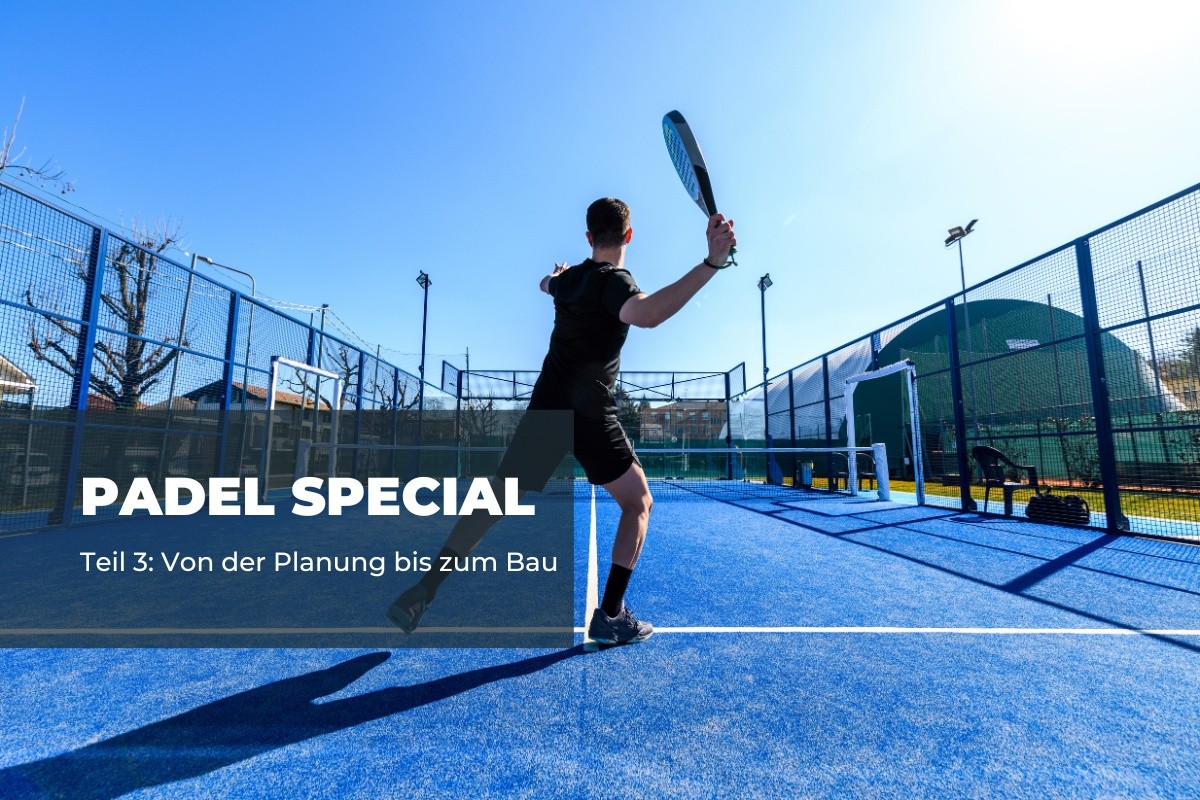
All good things come in threes! After learning in parts one and two of our padel special what padel is, what equipment you need, where the sport comes from, and what technical and tactical elements it contains, we now continue with part three, the final part of our padel special for now. Today you'll learn what you should consider and keep in mind when building a padel court . These are questions that many tennis clubs are currently grappling with. Our padel expert, Yannik Mann, has compiled the most important decision criteria for you . From planning and construction to maintenance and the not insignificant question of costs. And, of course, Yannik will also answer the question of whether building a padel court is "worth it."
Careful planning is essential before building a padel court. This includes choosing the right location, the number of courts, and, most importantly, selecting the right construction company.
The following points should be taken into account when planning a padel court:
 Our padel expert: Yannik Mann
www.padelmann.de
The construction of a padel court should be carried out by a company with experience . This is the only way to ensure that the court meets the demands of the game and has a long lifespan. Ask for reference projects that you could visit if you have any doubts, so you can see and feel how the materials were used.
The construction of a padel court can be divided into two phases:
After construction, regular maintenance of the padel court is essential. This primarily involves distributing the sand and cleaning the court walls. Maintaining padel courts is much simpler than maintaining tennis clay courts. Due to the back-and-forth movement of players in padel, sand accumulates on the back wall, in the corners, along the back wall, and in the center. The sand should be replenished regularly to ensure consistent ball bounce and sliding. Various tools are available for this purpose, from simple brooms to motorized machines that allow for the removal and redistribution of compacted sand from the bottom of the court.
The court should be maintained with motorized equipment approximately twice a year. Especially with outdoor padel courts, proper maintenance is crucial for the longevity of the artificial turf. The artificial turf typically needs to be replaced after 4-5 years. With proper care, its lifespan can be extended by at least a year.
A padel court alone currently costs between €25,000 and €35,000 on the German market, depending on the model. When comparing offers, be sure to check whether delivery is included or not.
For an outdoor tennis court with a foundation and installation, you can expect to pay around €70,000. Some providers already offer financing options, while others have mobile courts available for rent.
Building a padel court is a worthwhile investment, especially now that we in Germany are at the beginning of a major padel movement that has captivated our neighboring countries for years. Besides constructing the facility itself, effective promotion is crucial. This includes open play sessions, community building, match organization, league participation, tournament formats, and, of course, training.
If you are interested in building a sports field and need more information, please contact our expert Yannik Mann. Simply fill out the form below.
Learn from the best players and coaches in the world with the Hello Padel Academy. Founded in 2013 by former professional padel player Mauri Andrini, the Academy now operates academies in Belgium, Great Britain, Denmark, the Netherlands, Spain, and of course, Germany. Our padel expert Yannik is the head coach at one of the German academies. The academies offer coach training, player workshops, online courses, and padel camps.
Exclusively for you, we have two goodies at the Hello Padel Academy:
You shouldn't miss this!

Then feel free to send us your question using our form.
On our Padel Tennis Inspiration page you will find all blog posts on the topic of Padel as well as current Padel camps and TennisTravellerhotels where you can play Padel perfectly.





Sign up now and be the first to know about new tennis hotels and tennis camps, as well as great promotions. You
can unsubscribe at any time. Please see our privacy policy.