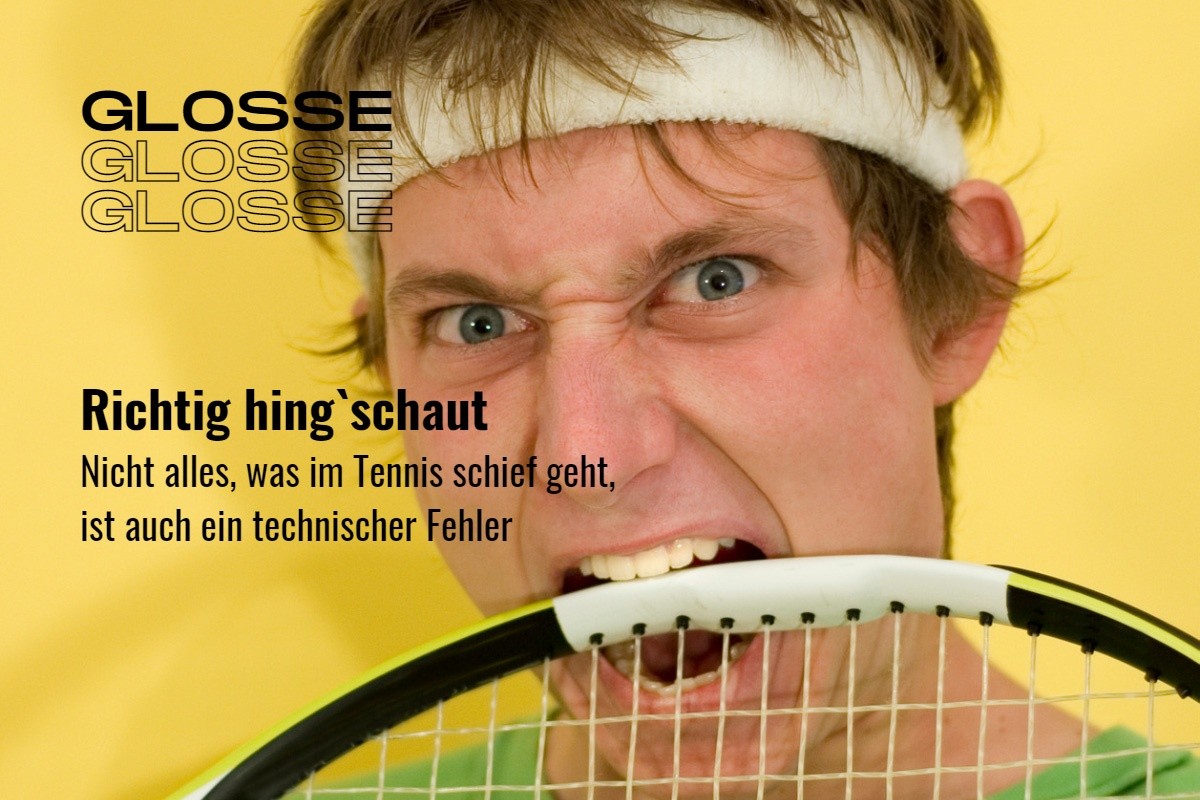
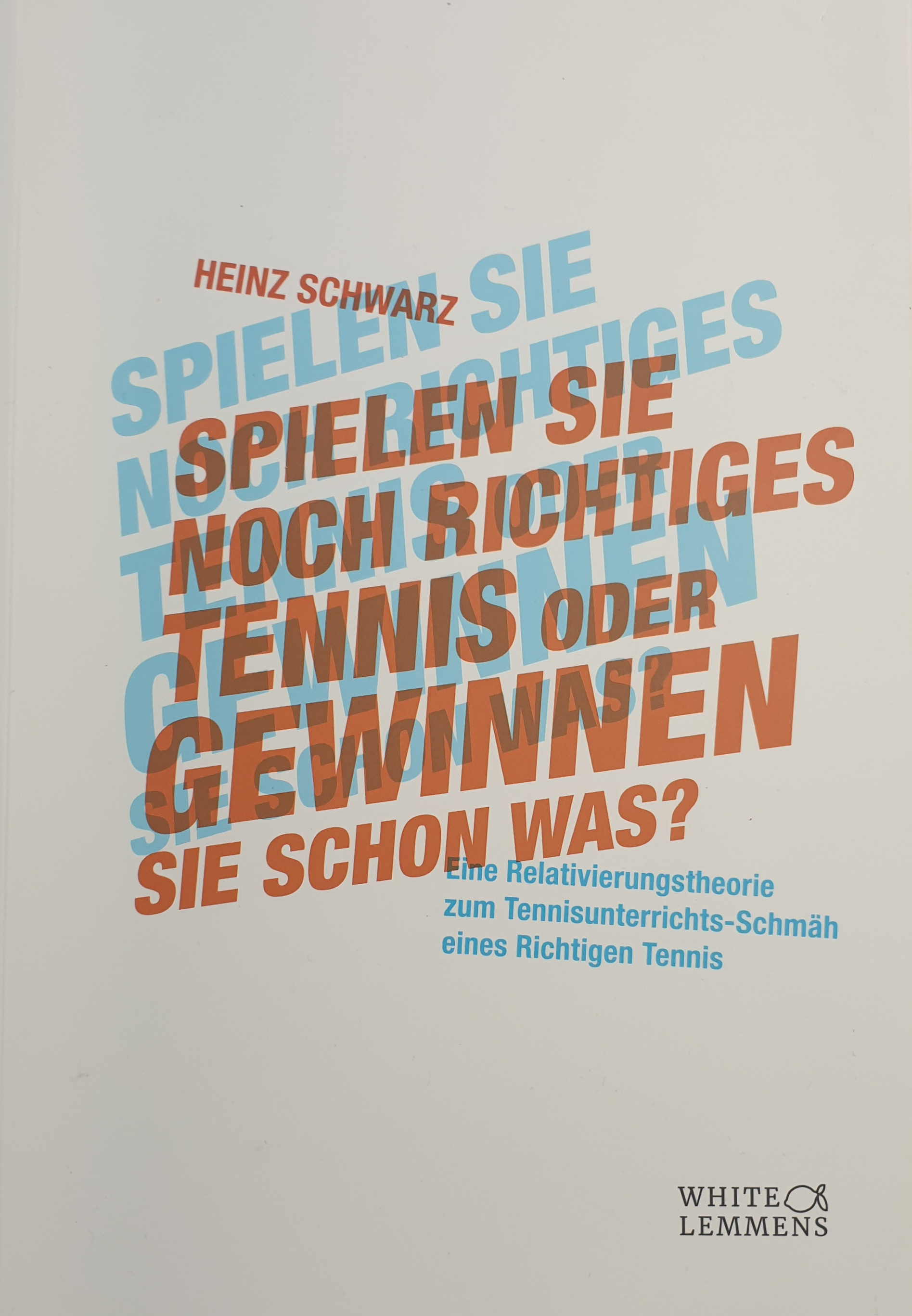
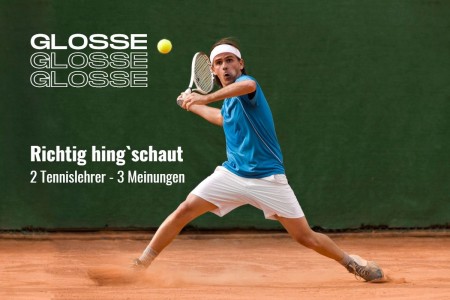
In the second part of Heinz Schwarz 's tennis column , "Looking Differently," author of the book "Are You Still Playing Real Tennis or Are You Already Winning Something?", the topic is mistakes. Yes, we all know them more than enough, right? After all, tennis is and always will be a game of errors. But why do we squander points we thought were in the bag, why do we leave 100% chances hanging in the net or against the fence? A technical error is quickly found as the explanation: too little spin, not closing the racket properly, and whatever other brilliant excuse we can think of. Heinz debunks the notion that all the mistakes you make have something to do with technique in his column titled " Not Everything That Goes Wrong in Tennis Is a Technical Error ." Learn why distance errors and motivational errors are frequent sources of error, especially in amateur and recreational tennis, and how you can combat them. As always, very entertainingly written – enjoy!
“If you only have a hammer, you’ll primarily look for nails!” is a proverb from the trades that describes what could be called “system-inherent and system-preserving thinking”.
Our hammer in the tennis world is the "technical correction". If something goes wrong, if you accidentally hit a perfectly placed ball out of bounds or into the net, then the technical errors you made are discussed or at least explained.
When I was young and cynical, I always exposed the fundamental flaws in this way of thinking by comparing it to someone who, drunk, drove their car into a ditch, totaling it, and then discovered that the oil pressure warning light was broken. "Yes, it's undoubtedly broken, but it's not the root of the problem!"
Today, being older and somewhat less cynical, I limit myself to thinking about my students' tennis and still believe that the "technical error in the true sense" is overestimated and that this overestimation of the "oil warning light" as an explanation for the consequences of accidents is not a useful approach.
Why do tennis players always seem to focus so much on "after-the-scenes analysis"? Mentally speaking, it would be better to put aside things that are "already over" and look ahead. The reason for thinking in this "after-effects" category is, of course, to prevent future accidents.
And that's precisely the problem: even if we disregard the oil warning light, which I introduced as a maximally polemical example, in tennis, comparable accidents are usually considered in terms of how the accident, which was primarily caused by drunkenness and excessive speed, could have been prevented if the ultimately unsuccessful driving maneuver had been executed with the quality that a completely sober Formula 1 driver could have achieved on a good day.
If one truly wants to use technical "post-accident analysis" to prevent future accidents, it would be advisable to consider alcohol consumption and the question of what speed one can safely control, both drunk and sober. It is also undeniable that improving driving skills could help prevent some accidents, but it is equally undeniable that this addresses the most difficult accident prevention model to achieve, because it requires far more than just a few clever analyses.
But to get specifically to the technical errors in tennis:
In my perception, there are 3 different types of technical errorsthat differ significantly in their basic structure and whose analysis is primarily geared towards different objectives.
There is the "technical error in the true sense"; that is, the error that is used as a "general explanation for everything" and whose analysis is often touted as a "cure-all" in tennis lessons. A "technical error in the true sense" would be one where you intend the right thing, are in the right starting position to achieve that intention, are fundamentally capable of doing what you want, and yet still only manage to execute something suboptimally in a specific situation.
The most common technical error in recreational tennis, especially among the "solid middle class," is actually a different one; I would call it "the technical error in the distance area." You have a specific desired shot and want to execute it at all costs; however, this would only be possible if you were within your comfort zone regarding the point of contact for that shot, which you weren't, otherwise you wouldn't have made a mistake. Most technical errors are essentially distance errors, and the "technical errors in the true sense" described are then merely collateral damage resulting from this distance error.
The most frequent technical error in the "upper middle class," where the first two categories of technical errors (in the strict sense and distance errors) are usually rare, I would describe as an "overmotivation error." Beyond a certain skill level, there's a tendency to shift the balance between risk and safety towards risk, and then technical errors inevitably arise. These are collateral damage of an "unbalanced motivation," which, if one is honest and thinks systematically and rigorously, are ultimately errors that one consciously accepts (and doesn't really want to prevent) on one's path to developing even better tennis.
Even though the popular suggestion in tennis lessons that the analysis of the "technical error in the true sense" would be the "jack-of-all-trades" for developing and optimizing one's tennis is tempting, it is unfortunately wrong or at least too superficial to allow one to emotionally work through it and constantly feel somehow guilty about it.
 Technical errors in the true sense of the word, simply happen (even though it would be nicer if they didn't happen too often), and I can tell you that as I get older and more experienced as a fairly successful player, I ward them off with the mantra: "Who do you think you are? Roger Federer?"
 The "spacing error" also occurs, but it is easier to combat in two ways:
If this happens, meaning you're not positioned correctly to play a really good shot, you have to play the right shot (i.e., a less demanding one that's still possible even in this suboptimal distance situation) and not try to execute the wrong shot as correctly as possible; the mistake people often make here isn't a technical one, but a strategic one, or to put it in modern terms so that we German speakers really understand: the mistake lies in the shot selection
Put simply – and here we come back to the purpose of technical improvements – with increasing technical quality, distance errors decrease because one becomes better at calculating distances and because, moreover, with increasing technical quality, the comfort zone for really good shots is enlarged (as can be seen very impressively with Rafa, who, with his lasso swing over his head, still manages a forehand topspin far outside a normal comfort zone, which I can't even manage when the ball is exactly in the absolute comfort zone of my forehand)
 The "motivational error" occupies a special position in terms of its classification because it usually doesn't actually occur, but is intentional and considered beneficial.
Which it is, in part, at least in the sense that the element of exaggeration and pushing risk factors to the limit is undoubtedly necessary and must be embraced if one wants to achieve something great.
This phase of a tennis player's life can be quite well described using a car analogy: "While it's better to practice driving a Fiat 500 for a long time and not immediately speed off in a Ferrari, in this phase, where one could also master the Ferrari, one tends to drive around on a forest path in the Ferrari and get annoyed that the damn thing, which cost half a million, keeps getting stuck!"
Or to put it another way, even if something is very good, it's not good for everything!
The author, Heinz Schwarz, actually holds a doctorate in law, but discovered his love and passion for tennis coaching during his studies, a passion that has stayed with him ever since. His coaching experience includes stints at the Niki Pilic Academy, which he managed as director and where none other than the young Novak Djokovic trained at the time.
Today, Heinz runs a tennis school in Dachau, Bavaria, and is a very active and successful senior tournament player. He is also an expert colleague and brand ambassador for Zischka Tennis Reisen. You can see Heinz live there on certain dates.

Part three of Heinz Schwarz's column "Looking Right" will be released in March and is titled "Coach Me Like Djokovic." That sounds very promising. Especially since you know that Heinz actually coached the young record-breaking Grand Slam winner during his time at the Niki Pilic Academy. Heinz manages to transfer world-class techniques to the average player. How and where exactly that's possible—you can look forward to finding out in part three of the column!
For those of you who would like to read more by Heinz Schwarz, we highly recommend the book "Do you still play real tennis or are you already winning something?" We have, of course, already reviewed the book, so you can find out more beforehand.










Sign up now and be the first to know about new tennis hotels and tennis camps, as well as great promotions. You
can unsubscribe at any time. Please see our privacy policy.