It is a particular pleasure for us to have Heinz Schwarz, author of the book "Are You Still Playing Real Tennis or Are You Already Winning Something?" , for a highly entertaining commentary. Under the title "Looking at It Differently," Heinz will present his unique perspective on the topic of "Real Tennis" in a three-part series.
"The idea of 'proper' tennis, which clearly dominates our industry, is not a closed scientific system but rather a tennis coach folklore passed down from one generation to the next, and which, let's not hide the fact, is also expected by the client. However, this system is designed in such a way that, in addition to its undeniable, albeit often less spectacular, main effects (as suggested by commercial interests), it inherently produces many irritations and a great deal of stress as side effects – among the students, the teachers, between the teachers and the students, and among the teachers themselves," says Heinz.
"Looking at It Differently" is therefore primarily about perhaps better balancing the main and side effects of the desired and intended image of "proper tennis." New ideas, perspectives, and very practical examples will surely inspire you! Let's start with part one, entitled "Two Tennis Coaches - Three Opinions." Enjoy reading!
And now Heinz begins with the first part of his three-part commentary "Looking Differently":
"Who doesn't know the feeling, tennis camp, you look forward to it all year, the location is beautiful, the weather is perfect, the hotel is great, the après-tennis among like-minded people is wonderful, the coach is somehow okay, but totally confuses me.".
From the other side, that is, from the coach's perspective, there is no more "pleasant" question than the one that almost inevitably arises from this partial stress scenario of the student: "My coach at home or my coach from last year says this and that?!"
Can't the tennis instructors agree on one option, and secondly, should they even do that?
Apart from the fact that these questions are particularly acute in the camp situation because there is a kind of "forced assignment" between coach and student, which as a rule (except for team training and youth training) does not exist at home and certainly does not exist in higher-level sports (where you simply replace the coach if he is not a good fit), these are questions that ultimately fall short and do not solve the problem.
Therefore, I would like to see different questions and different approaches to solving the problem "Trainer confuses student and student cannot escape the trainer!".
To let you in on a little secret, the most popular approach from the coach's perspective is to redirect the student's content-related discomfort to other levels, usually the athletic one (by letting the student run themselves to exhaustion so that they are at least satisfied in terms of their physical performance and then usually "shut up" because they are too exhausted to complain any further).
There would of course also be detours on the social level (emphatically charming or authoritarian behavior) and on the tourist level (boat trips and grilling sardines).
In my commentary articles, I would like to offer you a solution based on understanding the content.
Aside from the fact that one can, of course, simply be unlucky and end up with a bad coach, or at least one who isn't a good fit (in which case, in the organizational reality of camps, one will probably have to do a lot of walking and eat a lot of sardines alongside this toad), and aside from the fact that on a holiday that one has been so looking forward to and so desperately needs, one is sometimes inclined as a customer to perceive a nice room as bad and even a good coach as bad, there is a fundamental content-related level regarding tennis lessons, the understanding of which could be helpful in such situations.
This is essentially based on the fundamental expectation of tennis lessons (which usually also coincides with one's self-image): tennis lessons should show one as objectively as possible how everything should ideally be in this sport; tennis lessons are generally based on a "could, should, must" paradigm.
And the descriptions of how it should be done are usually of a (tennis) technical nature and tend towards the "apodictic and pseudophysical", meaning simply put, "this is how it is done because it cannot be done any other way from a scientific point of view, and if someone says otherwise, he is a bad physicist!"
And that's precisely why everyone has a problem that is usually quite emotionally acted out when things don't go as they should in "the harsh reality of recreational tennis".
If everything is "physics" and it still doesn't go as planned, then there are only two explanations for this: either the explanation is wrong or the student is too stupid to implement it correctly, and if the explanations from us "sunglassed physicists in our guest lectures by the sea" are also obviously contradictory, then there is usually a "really good" atmosphere in the room.
Even though the entire system of "tennis lessons and learning tennis" is far more complex than I can present in a short commentary, the problem described here can usually be solved or at least mitigated with two fundamental approaches to understanding it:
 Everything we recommend (or command) to tennis coaches can be reduced to a basic target matrix. We essentially recommend improvements in the following areas:
 Furthermore, everything we recommend (or command) to tennis coaches can be reduced to a dual information system:
Most stressful situations in tennis lessons can be resolved relatively easily with an understanding of this content matrix in combination with an understanding of this information system (if one even wants to do that, because much of the "magic of the optional and ideal" inherent in tennis would be destroyed in the process).
So, for example, if one coach raves about the "open stance" on the forehand, he is usually focused on swing orientation, while the "standing sideways" coaches are more focused on lateral stabilization.
If a coach wants to help you directly, then of course they must not change your usual stance (whether open or sideways, the main thing is "your stance") and if you (your coach and you) do change it, then you must decide together and know that "you will hardly ever have to practice this intensively for 5 years to even get a little bit of it right!"
“People don’t understand,” said Niki Pilic, the grandmaster of simplification in our complicated industry, whom I had the privilege of working with and observing for many years, “that’s the forehand spin, not the forehand spin,” or in other words, much is “correct,” you just have to learn to assign it “correctly”!
The author, Heinz Schwarz, actually holds a doctorate in law, but discovered his love and passion for tennis coaching during his studies, a passion that has stayed with him ever since. His coaching experience includes stints at the Niki Pilic Academy, which he managed as director and where none other than the young Novak Djokovic trained at the time.
Today, Heinz runs a tennis school in Dachau, Bavaria, and is a very active and successful senior tournament player. He is also an expert colleague and brand ambassador for Zischka Tennis Reisen. You can see Heinz live there on certain dates.
Part two of Heinz Schwarz's commentary "Looking Right" will be published in February and is titled "Listen to the Hammering!" Everything in tennis lessons seems to be reduced to technical errors. Heinz Schwarz suggests that this is because we love the hammer of technical instructions and corrections so much and are therefore constantly searching for nails. Are all errors in tennis really technical errors? Stay tuned!
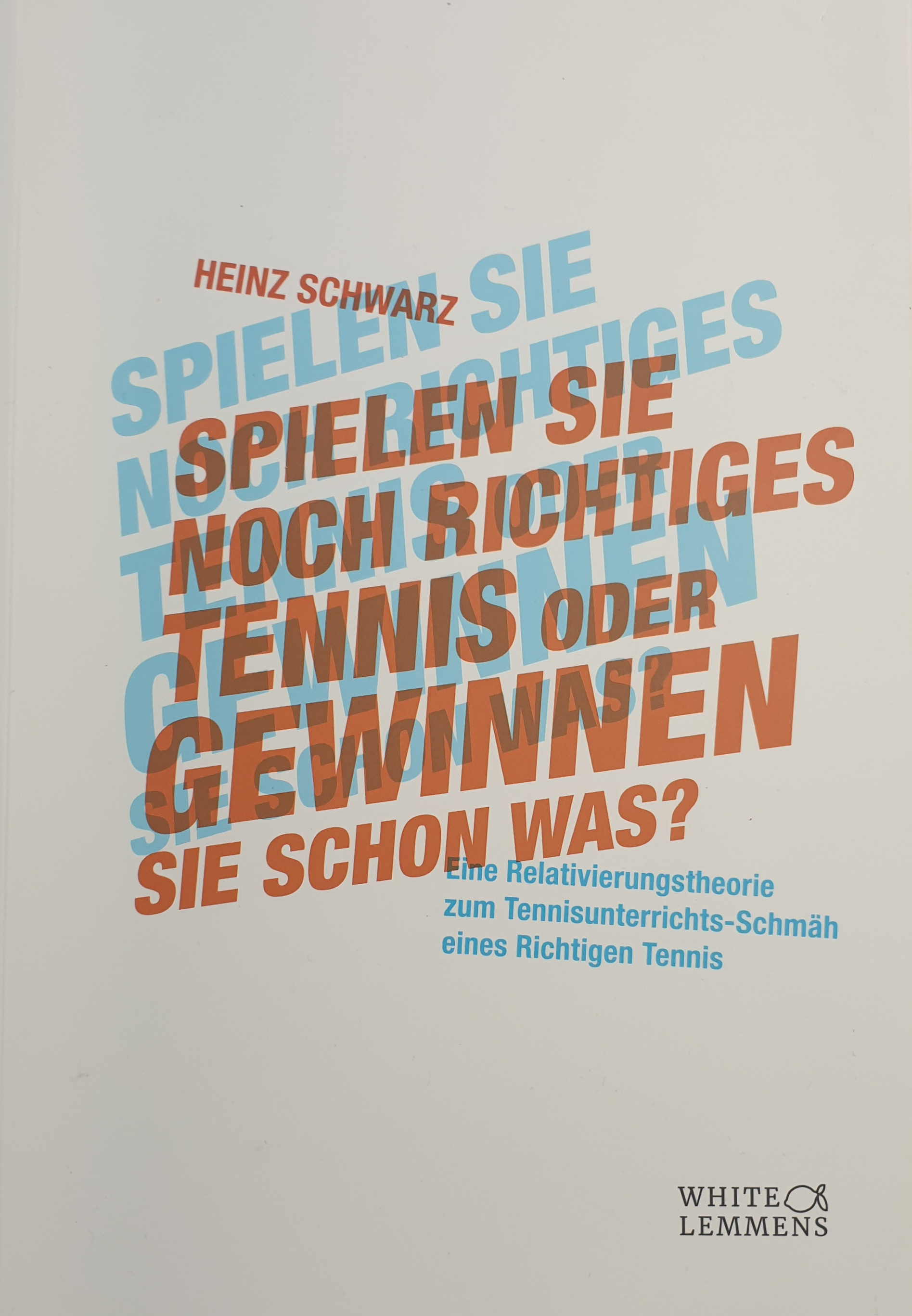
For those of you who would like to read more by Heinz Schwarz, we highly recommend the book "Do you still play real tennis or are you already winning something?" We have, of course, already reviewed the book, so you can find out more beforehand.








Sign up now and be the first to know about new tennis hotels and tennis camps, as well as great promotions. You
can unsubscribe at any time. Please see our privacy policy.