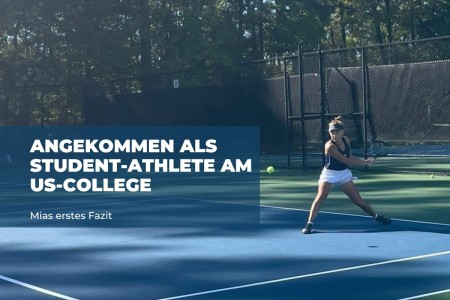

Playing tennis and studying at a US college is a dream for many young tennis players. To make this dream a reality, many US universities offer tennis scholarships. With this substantial financial support, countless tennis players from around the world are able to fulfill their dream of playing college tennis each year. But who can actually apply for a tennis scholarship at a US college ? How does it all work? And there are countless other questions that my husband and I had at the beginning of the year when our daughter Mia unexpectedly expressed her desire to study and play college tennis in the USA.
Over the next few months, we'll be taking you along on Mia's journey to US college . This will give you an idea of everything that needs to be done, considered, and prepared—both as a future student-athlete and as a parent. In the first part of our series, we'll tell you how Mia's wish to attend college came about, how we took the first steps, and what decisions have already been made. Let's just
say this much: it's been an incredibly exciting start!
"Mom and Dad, I'd like to go to a US college to play tennis after I graduate from high school. Is that still possible?" Our daughter Mia approached us with these words in mid-January. To be honest, we were completely taken aback. It wasn't that the topic of college tennis was new to us. Many kids of tennis friends have been, or are currently, in the US on tennis scholarships. We'd brought it up with Mia a few times a year or two ago, but studying abroad was never an option for her. Finishing high school and then studying business administration or economics here was Mia's plan after graduation. At least until last Christmas...
Over and after Christmas, however, things changed quite a bit regarding the original plan. After some conversations with tennis buddies who were currently in the USA, Mia became increasingly interested in college tennis. This remained a secret from us. Finally, in mid-January, she made her decision and told us of her wish to go to the USA.
Of course, we asked about the reasons for this change of heart: "After graduating from high school, I want to have a completely new experience. Away from home, out of my familiar surroundings with family and friends. Finally, I want to play tennis a lot and regularly, without long commutes and high financial costs." And, very importantly for Mia: she's really looking forward to the much-talked-about team experience. Playing with the team, instead of competing as an individual in tournaments, she thinks that's just fantastic. Being together as a team, even off the tennis court.
The long-standing concerns about being far from home and alone were blown away.


Even though we were initially taken aback, one thing was perfectly clear to us: we wanted to support her dream, because we think the opportunity to study in the USA on a tennis scholarship is simply fantastic. So what to do? First, we consulted Aunt Google about college tennis: what are the requirements? For example, we weren't sure if it was already too late to apply for summer 2023 (August). We read that it's best to start looking for a scholarship 1-2 years in advance. This point needed to be clarified as soon as possible.
However, what our internet research showed us was that Mia actually fulfills all the requirements to receive at least a partial scholarship at a US college:
There are generally no fixed requirements for a tennis scholarship. Rather, the overall package is what counts, ultimately determining the amount of the scholarship.
Next, the mobile phone was used. Many long phone calls with tennis friends and coaches who had experience with tennis scholarships at US colleges made one thing clear: firstly, things needed to move quickly, and secondly, we needed professional support because we couldn't manage an application on our own.
Through conversations and online research, we learned that there various professional agencies that can help you find a tennis scholarship. These range from small, relatively unknown agencies to the leading German agency in the industry, Keystone Sports, which includes the provider uniexperts, already familiar to us.
It's advisable to take a close look at the websites beforehand , as several differences become apparent, such as the professionalism of the presentation, the detailed description of the placement process, and yes, even the costs (which are sometimes not published at all...). The financial terms, in particular , vary considerably between agencies. Generally speaking, you should budget a substantial sum for agency support (between €3,000 and €10,000). This agency fee is payable regardless of the placement outcome.
Our friends' experiences regarding professional support and the smoothness of the application process. Naturally, we paid close attention to this, as it's something you can't assess beforehand with any agency. And even though every agency is different, these testimonials were extremely helpful and crucial to our decision.
If you Google "agencies for tennis scholarships at US colleges," you'll get numerous recommendations, which we explicitly won't mention here because we can't evaluate them. Since we were under a lot of time pressure, we did look at many different agencies online. However, we only spoke to one agency in detail: uniexperts. Why? 80% of our tennis friends had used uniexperts and were consistently satisfied. So we figured it couldn't be all that bad.
So we arranged an initial consultation with uniexperts , the so-called opportunity assessment. Our daughter Mia joined us for this video call. This was explicitly requested by Sandy Franz, our contact person. We thought that was great, since it's primarily about her. Sandy is a native German, went to a US college as a student-athlete himself, and now lives with his family in Charleston. A cool and open guy, he wanted to know a lot about Mia during the video call: why she wants to go to the US, where she wants to go (region, small, medium, or large university), what she wants to study, what she hopes to achieve in tennis, and much more. Before the call, we gave Sandy some tennis facts about Mia: her ranking, performance level, playing class, etc. But her school grades were also important to him. A scholarship can come from both sources; that is, there are academic and tennis-related scholarships.
Based on this information, Sandy was able to give us an idea of what a year of study with (or despite) a scholarship would cost us. This is significant information, as in addition to the one-time agency commission, there are also ongoing monthly expenses (university fees with a partial scholarship, pocket money, etc.) as well as one-off costs for flights, visas, test fees, and so on.
After the video call, Mia knew she wanted to tackle the application process with Sandy. And since I also felt we clicked and the overall costs were manageable for us, we gave Sandy, and therefore uniexperts, the green light the next day. It was a decision for a project with an open outcome. Because what the scholarship would actually look like, which university Mia would study and perform at, and many other questions were still completely up in the air at the time of signing the contract with the agency. Everyone should be aware of that. Rather, the journey together now begins, along with the search for the right university for Mia.
In the next part of our series, we'll show you how Mia created her application profile and what needs to be considered and done. It's going to be extremely exciting!
If you have any questions about college scholarships in the meantime, or if you'd like to know specifically how we approached things, feel free to contact me anytime














Sign up now and be the first to know about new tennis hotels and tennis camps, as well as great promotions. You
can unsubscribe at any time. Please see our privacy policy.