
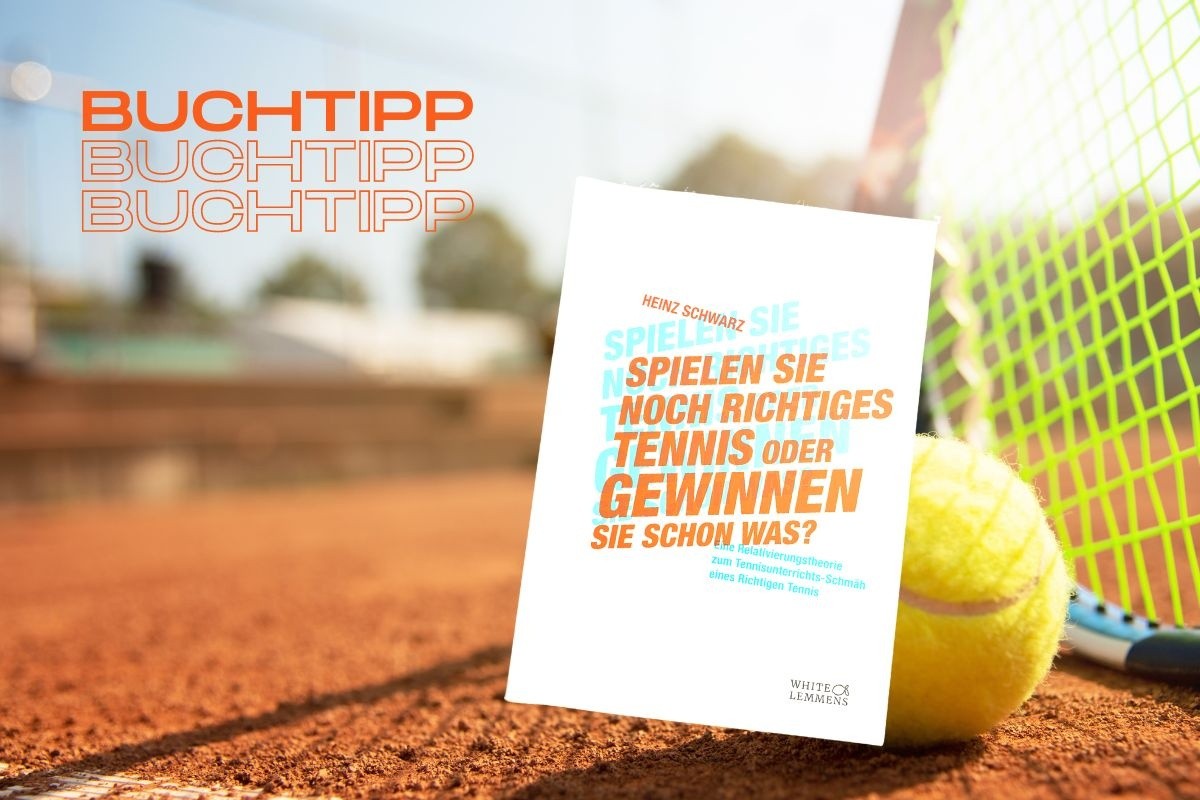
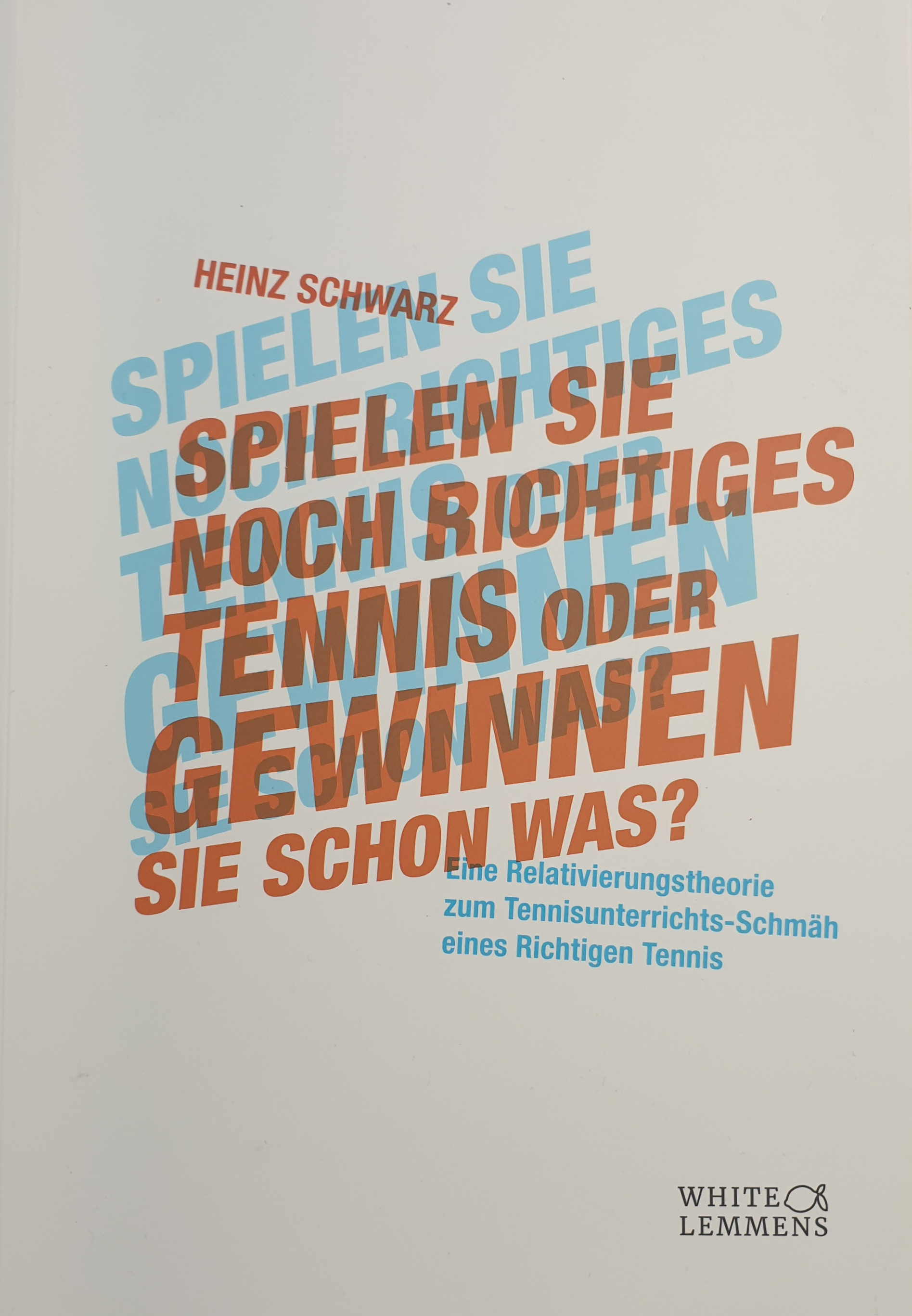
The book title alone, "Are You Still Playing Real Tennis or Are You Already Winning Something?", piqued my curiosity. When I then read the subtitle of Heinz Schwarz's debut work, "A Theory of Relativity on the Tennis-Teaching Joke of 'Real Tennis'," there was only one thing to do: open the book and start reading. And that's exactly what I did during my summer vacation on the beach, without a single break. The 132 pages that the Austrian-born, now Bavarian-based tennis coach has written about the sense or nonsense of "real tennis" are truly entertaining. The author rather rebelliously questions the teaching methods of many of his colleagues who train the average tennis player. The book explores why and how "average tennis players" should be trained to ultimately get the most out of them, or at least approach their full potential. And he does so in a way that often made me smile under the Corsican sun!
In the first part of the book, the author explains what he actually means by "proper tennis" and why, in his view, the way tennis coaches teach "proper tennis" is simply wrong. Does a recreational player absolutely need a semi-grip for their serve? Or must they necessarily stand sideways to play "proper" tennis? The author is quite critical of many of his coaching colleagues. They all too often try to impart the "correct method" without paying attention to progress or success. In his opinion, the focus should be on results, not on the complicated transmission of knowledge, which is completely overwhelming for many recreational players. Unrealistic perfectionism must give way to pragmatic and individualized approaches. It's a sometimes rather "heretical" approach, examined from many angles. To all tennis coaches: this is a topic that sparks great discussion!
The second book gets more specific: the author provides numerous training tips and recommendations for matches. What is technically important for the various basic strokes, especially in a match? The author knows far too many "beautiful players" who hit everything in practice but are then unsuccessful in matches. What is tactically important for recreational players in a match, and how can this be practiced and transferred to a competitive situation? The mental aspect is also given ample attention in this part of the book. This is an area that is so important for recreational players, as it often determines victory or defeat. And here, too, the author provides truly excellent and, above all, easy-to-implement recommendations and tips.
In the third and final part of the book, the "Little Release Theory," the author describes his top ten tips for learning or improving tennis. Whether it's advice for overcoming the "I'm too sexy for this game" trap or his suggestions for a holistic view of one's own tennis game, this section offers a wealth of important advice, presented concisely and practically, with effective implementation. Effectively leading to tennis where you win and enjoy yourself.
The author, Heinz Schwarz, actually holds a doctorate in law, but discovered his love and passion for tennis coaching during his studies, a passion that has stayed with him ever since. His coaching experience includes stints at the Niki Pilic Academy, which he managed and where none other than the young Novak Djokovic trained. For many years, Heinz worked for the tennis travel agency Hannes Zischka. Hannes Zischka, a proponent of Heinz's training theory for recreational players, also wrote the foreword to the book.
Today, Heinz runs a tennis school in Dachau, Bavaria, and is a very active and successful senior tournament player.
As I mentioned at the beginning, I read the book in one sitting. Often with a smile on my face, but also often with a few unspoken "But..." thoughts running through my head. Many of my fellow tennis coaches would find Heinz's theses more than controversial. However, in my opinion, Heinz manages to dissect the two "worlds" of "proper" tennis and his own view of the game in such a way that the two worlds aren't as far apart as one might initially think.
What I would have liked were a few illustrative or photographic elements, which would certainly have made the book more visually appealing. In addition, there could have been more concrete training recommendations and exercises, as I found these particularly informative for all "regular tennis players".



Sign up now and be the first to know about new tennis hotels and tennis camps, as well as great promotions. You
can unsubscribe at any time. Please see our privacy policy.