
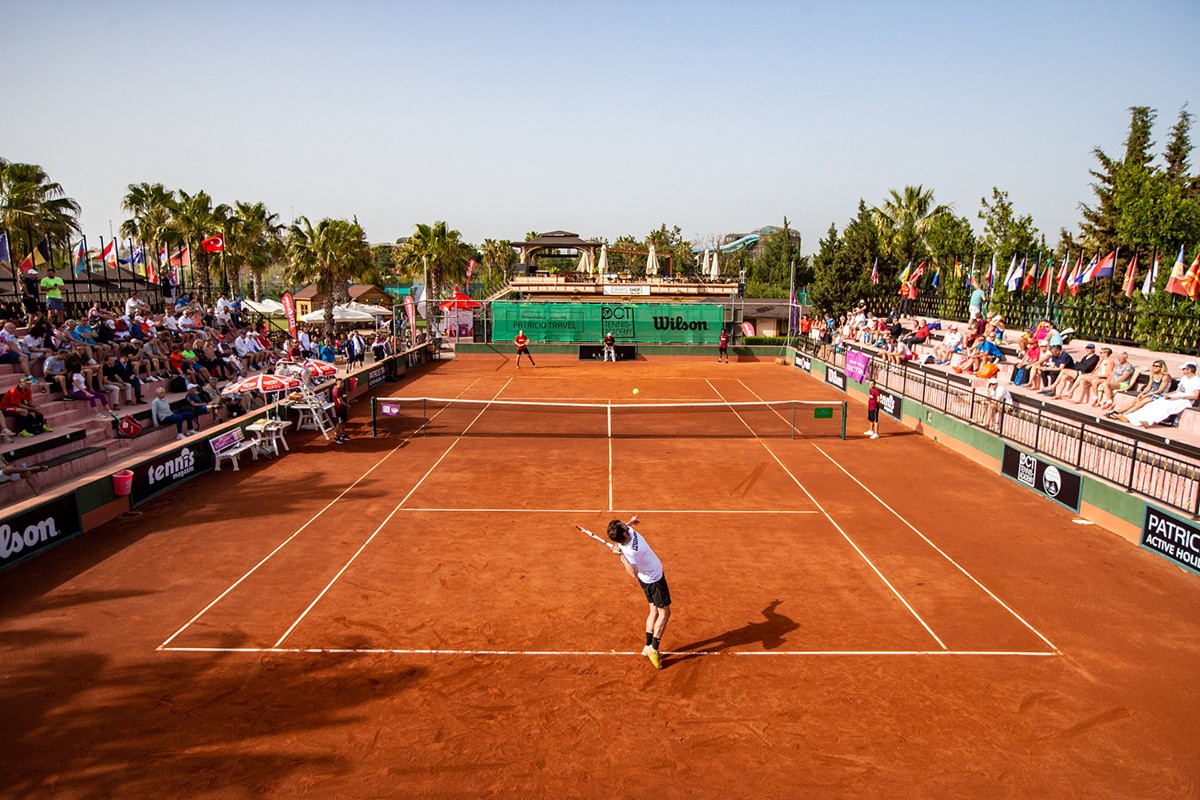
Getting started in tournament tennis as a senior can raise a few questions for many players. What kinds of tournaments are there? What tournament categories exist at the regional, national, and international levels, and who are the respective tournaments suitable for? In connection with my own personal " Road to Manavgat ," the tournament trip with Patricio Travel to the 23rd International Wilson Masters Open next March, I've taken a closer look at the senior tournament landscape. Even after a 20-year hiatus from tournaments, the tournament categories aren't unfamiliar to me, as I've traveled extensively with my children to national and international tournaments in recent years. And the junior and adult tournament scene isn't dramatically different from that of seniors. I'd like to give you a brief overview of the senior tournament scene soon and perhaps clarify a few questions and uncertainties. Because one thing is certain: playing in tournaments is perfectly possible at a senior age and offers players of all skill levels plenty of opportunities to be active.
A brief note beforehand: in the following, we describe the different tournament categories, focusing on the tournament scene in Germany for national ranking and performance class tournaments. The systems are sometimes very similar in other European countries.
The ITF World Tennis Masters Tour is the international tournament series of the International Tennis Federation (ITF). In the age groups 30, 35, 40 to 90+, singles, doubles, and mixed doubles competitions are offered. There is a worldwide ranking for each age group. The ITF tournaments are suitable for high-performing, internationally oriented senior players; however, average players can also easily try their luck at one of the lower-ranked ITF tournaments.
Generally, there are no skill level restrictions for ITF tournaments. However, players must reach the minimum age required in the tournament year and be members of a national tennis association (e.g., DTB). Additionally, each participant needs an ITF IPIN, an international player ID, which can be applied for via the website and costs an annual fee (approximately USD 35–45).
ITF tournaments are classified into categories from MT100 (beginner) to MT1000 (top tier), with higher numbers offering more ranking points. The categories (e.g., MT200, MT400, MT700, MT1000) reflect the strength and organization of the tournament and influence the number of ranking points earned.
You can register for an ITF tournament online via the ITF tournament platform www.itftennis.com/en/itf-tours/itf-world-tennis-masters-tour/ . An international tournament calendar shows which tournaments are taking place during a specific period. There are separate registrations for singles, doubles, and mixed doubles, although doubles and mixed doubles can often also be registered on-site at the beginning of the tournament week. The registration deadline is usually 2–3 weeks before the tournament begins.
Entry fees are relatively high compared to national tournaments, ranging from €40 to €70 per discipline. However, indoor tournaments can sometimes charge significantly higher fees, exceeding €100. Generally, doubles and mixed doubles competitions are often cheaper than singles competitions.
In addition to the main draws for each age group, there is usually a consolation round. Depending on the tournament, play is either a knockout system or a group stage (round-robin). Normally, one singles match is played per day, best of three sets with a match tiebreak in the third set. Sometimes the third set is played out.
Ambitious players can compete in national ranking tournaments and collect points for both the DTB senior ranking and their performance level (LK) points. In DTB senior tennis, tournaments are categorized according to the Tournament Round Points (TRP) system. The category (e.g., S-6, S-5) depends on the quality of the field (ranking, LK level) and the prize money, with higher categories (S-1 to S-4 for seniors) for stronger tournaments that award more TRP points. Classification is based on age groups (e.g., S60, S50) and performance.
Age groups are generally played from 30 or 35 years of age.
Admission and seeding are based on ranking or a combination of ranking and performance level (LK). Some tournaments have participant limits, so the ranking or performance level is decisive for tournament participation.
There are different categories, e.g., S-7, S-5, S-4, S-3... up to S1, the highest category. The tournament category determines the number of points that can be collected for the ranking; the lower the tournament category number, the more points can be collected per round. This means that the highest tournament category, S-1, awards the most points. The classification of a tournament into a category is determined by the association based on the quality of the field of participants (rankings) and the prize money.
Tournaments are registered via the national tournament platform, in Germany this is tennis.de . The registration deadline is only a few days before the tournament begins. Acceptance and subsequent seeding are based on ranking position, followed by performance level (LK).
Entry fees average €30–50.
The tournaments are generally played in a classic knockout format, sometimes with a consolation round. Two rounds are played per day, but three matches per day are not permitted. Seeding is based on ranking, then on performance level (LK). Matches are played as best-of-three sets, with a match tiebreak as the third set.
LK tournaments are geared more towards recreational tennis, where players with varying skill levels (LK 1-25) compete in one-day or weekend tournaments. These tournaments also feature different age groups, and sometimes have LK restrictions to ensure that higher-level players compete amongst themselves. LK tournaments are
suitable for beginners in competitive tennis, recreational and club players, as well as seniors seeking match practice and a way to improve their LK rating.
To participate in a ranking tournament, you must have a player ID and be a member of a tennis club. The club official can apply for the player ID.
Tournament registration is done via tennis.de , and the registration deadline is only a few days before the tournament begins. The registration fees are somewhat lower compared to the other two tournament types.
One of the most common formats of ranking tournaments is a one-day tournament using the so-called spiral system, in which each player is guaranteed two matches: one against a higher-ranked player and one against a lower-ranked player. In these one-day tournaments, two matches are scheduled per day. Weekend tournaments, on the other hand, can also be played in groups or using a knockout system, sometimes with a consolation round.







Sign up now and be the first to know about new tennis hotels and tennis camps, as well as great promotions. You
can unsubscribe at any time. Please see our privacy policy .