
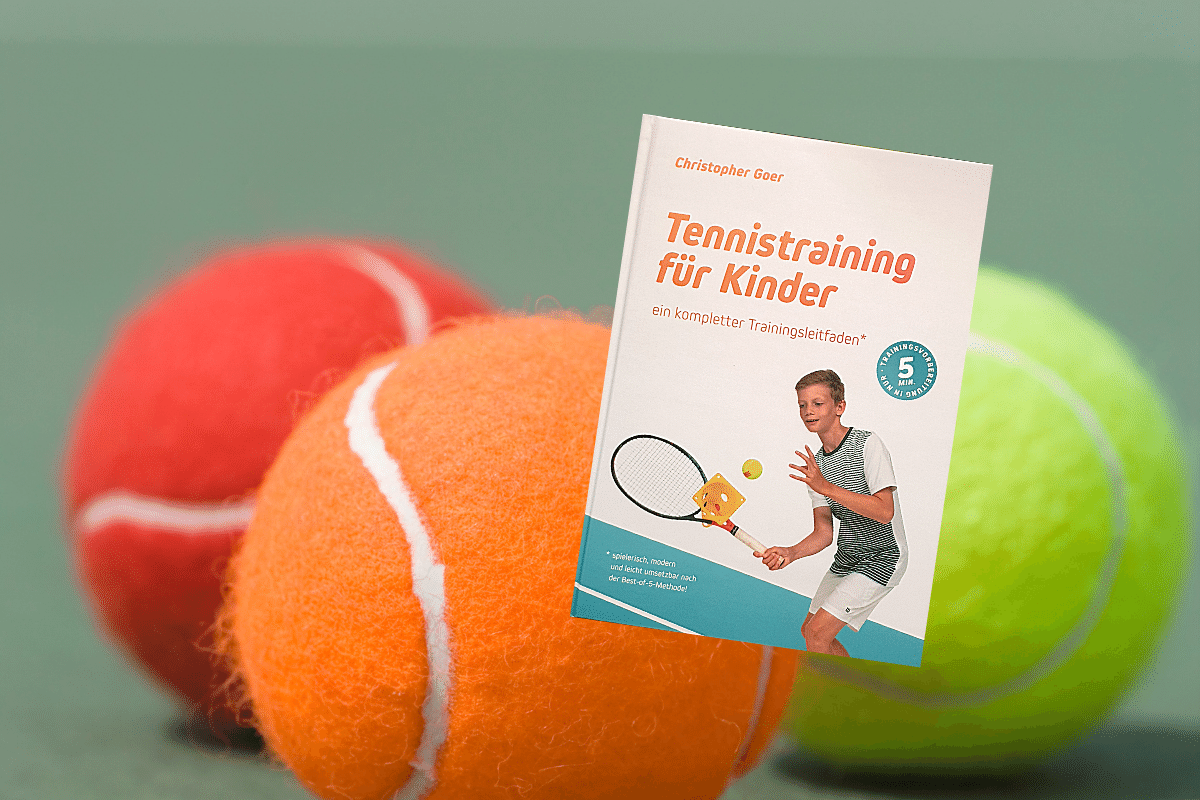
I had the pleasure of holding Christopher Goer 's book, "Tennis Training for Children - A Complete Training Guide," fresh off the press . This book is designed to introduce newcomers to the world of tennis coaching. It's concise, clear, and comprehensive, yet packed with in-depth information, exercises, and much more. The result: a fantastic book that should be on the hands of all teenagers and young adults who coach children at a club. A book whose title delivers on its promise: a complete training guide.
The author of the guide, Christopher Goer, is a tennis coach through and through. He has 30 years of coaching experience, including 15 years running his own tennis school and 20 years as a physical education teacher in secondary and primary schools. So he knows what he's talking and writing about. And he knows perfectly well that it's often quite difficult for "coaching rookies," meaning beginners in the coaching business, to structure training sessions "correctly." It often doesn't help that the rookie coach is a great player himself. That's exactly how it was for Christopher at the beginning of his coaching career. He simply started training without a plan and gave it his all.
Christopher wants to make it easier for his young coaching colleagues to give their best with this guide. And in my opinion, he succeeds brilliantly.
Of course, the tasks of a tennis coach are complex and multifaceted. To reduce complexity and focus the guide on the most important points, you'll find the so-called " BEST OF 5". These are tips that are easy to implement, proven effective by experience, require little effort or resources, but offer maximum reliability. A great way to continually remind yourself of the most important points in your coaching work.
The book doesn't start directly with training exercises. First, it describes the coaching profession and the role of a coach. How should a coach present themselves, what are the no-gos, and what training styles exist? I personally find it so important for junior coaches to be able to read all of this in a concise format. They need to, and should, become aware of their function as coaches—what they project to the children and what role they play within the club. The DSDS principle its place, explaining that its four pillars—discipline, independence, differentiation, and play—allow for the optimal use of a training session.
Several chapters show tennis coaches what to pay attention to during training and what's important when working with children. How can a good relationship with children be built? Why are fair play and team building so important? Dealing with the parents of young tennis players is becoming increasingly important. And here, too, Christopher offers helpful top five tips.
Chapter 10 then delves into the specific structure of the training session. For context: the target group for this tennis training is children up to a maximum of 15 years old who play tennis as a hobby and want to learn the game.
From warm-ups and exercises for the youngest children (3-5 years old), through levels Red, Orange, Green, and Yellow – everything is covered with numerous exercises and games. Essentially, all the exercises in the book can be adapted to different court sizes and ball types. Overall, the book provides a comprehensive collection of games.
But of course, the training guide also covers the topic of technical instruction . After a brief, fundamental introduction to didactics, the book proceeds chapter by chapter through the individual basic strokes. It always follows the same pattern: first, the most important technical aspects are listed, then the focus shifts to the most important movement characteristics for each stroke. The guide concludes with a methodical sequence that the coach can use to teach the technique. Finally, it includes the five most common mistakes for each stroke, along with possible corrections.
At the end of the book, novice trainers will find sample training plans for the different levels and a brief guide to equipment.
I was simply thrilled with this book. The layout and design are fresh, modern, and very clear. It perfectly complements the excellently structured content. The guide truly is a guide, a tool that optimally prepares and supports aspiring coaches in their important role. Of course, many of the game formats aren't new. However, they are perfectly integrated and explained within the context of each chapter topic. Concise, clear, and easy to understand. That's all you need.
I will definitely recommend this book as "required reading" for our motivated young coaches at our club. Incidentally, television presenter Tom Bartels plans to do the same. He is the chairman of a large Cologne tennis club and wrote the foreword to the book.











Sign up now and be the first to know about new tennis hotels and tennis camps, as well as great promotions. You
can unsubscribe at any time. Please see our privacy policy.