
The Failed Attempt Paradox , or How to Tame Your Inner Monkey. That's the title of our latest mental tip. If you think you don't have an inner monkey, you'll get to know one today thanks to our mental expert, Dr. Sebastian Altfeld. He explains why this inner monkey isn't a bad thing at all and what it has to do with the failed attempt paradox. And you'll be surprised, because every tennis player is already familiar with both the failed attempt paradox and their inner monkey. You just might not have been able to understand them properly before. We hope you enjoy getting to know your inner monkey. And even more importantly: we wish you success in dealing with it "correctly." To help you with this, Sebastian provides a worksheet that you can use to conduct a so-called 3S reflection on your game and your competition. Sounds exciting? It is, and it will definitely help you improve your game!
Players and coaches alike are familiar with the failed attempt paradox. However, they're usually unaware of it, even though it can have a significant impact before, during, and after a game. Since few people know about it, I'm aiming to shed some light on it with this article. So let's get started.
The knowledge of how our fast-twitch brain controls our emotional states and behaviors, and how we are, unfortunately, mostly just passive participants. This part of the brain is given different names in the literature. Some call it the reptilian brain, some the autopilot, and some even "the little fucker in your head." We at Ready2Perform refer to this part as the monkey. The monkey represents our associative memory and is meant to activate so that we react intuitively to situations. This serves the purpose of keeping us safe in dangerous situations. So, instead of thinking about the danger of the saber-toothed tiger and then running, we should flee immediately.
This example shows that the "monkey mind" is an ancient part of our brain, always ready to chime in. It wants to help us and do what's best for us, both on and off the tennis court. This knowledge is highly relevant to everyday life. The problem is, metaphorically speaking, it's just a monkey and doesn't think logically. And I'd like to demonstrate this with a small experiment before introducing the failed experiment paradox.
Please read the following instructions before jumping down to the words. This is important!
The task is to name aloud the color in which the following words are written. One word at a time, but as quickly as possible. So again, name the color, not read the word. Ready? Let's go!
Blue → Green → Yellow → Red → Purple → White → Black → Blue → Yellow → Green → Red
If you read the word instead of the color, even though you meant to do something else, that's okay. It illustrates how our brains work. Our primal instincts react automatically to stimuli and sometimes draw conclusions, even if they aren't correct. This happens automatically and can't be prevented. We can only learn to deal with it.
If you were able to name the colors accurately and didn't experience the described effect, then you may have noticed that it took considerable conscious effort to resist the impulse to say the word. Consequently, this also proves that the monkey wants to take the lead. This awareness is an important first step.
Being mindful of what's on my mind is essential. After all, how can I deal with something I'm not even aware of? Because, as you probably already suspect, the "monkey mind" has a significant influence on our lives and our performance on the field, especially when we're unaware of its presence. If you'd like to learn more about the "monkey mind" and how to manage it, I recommend our Ready2Perform program. Here, you'll get to know your "monkey mind" very well and learn important strategies to help you deal with it effectively under pressure.
To illustrate this, I'll use a typical situation from a player's perspective, one I regularly encounter in my practical work. Let's take a youth player who is playing their first season with an adult team. However, we could use any other situation, such as the club championship final, the match against a special opponent this weekend, or my loved one watching my match today. But for now, we'll use the youth player as an example.
What expectations does this player have of themselves, and how many missed shots are they allowed to have in their first match of the season as an adult compared to a junior? Think briefly about how many missed shots are acceptable and write that number down. Perhaps a quick definition of missed shots: Missed shots are recurring actions in a tennis match that can go wrong. This includes virtually any behavior that leads to the opponent winning the point: hitting the ball into the net, a double fault, the ball going long, etc. What number of missed shots in a best-of-three-sets match is "acceptable" to you?
I often get the following answer: "None, because I have to perform, since the others are both better and older than me. I can't afford to make any mistakes.".
Notice anything? You've probably realized that "no errors" is unrealistic in a sport like tennis, where mistakes are common. This would be the first fallacy of perfectionists. After all, how many players do you know who have played a perfect tennis match without dropping a single point? The average number of unforced errors per match in a Masters senior men's and women's tournament is around 26.
In the example above, the expectation would therefore be that 100 percent of my shots are successful. Realistic? Of course not. But I don't actually want to focus on this cognitive bias of the monkey. Another cognitive bias has crept in: the failed attempt paradox. What does the young player expect of themselves in a more complex situation? And yes, adult games are in most cases more complex or physical compared to youth games. Let's take a look at the red line in Figure 1.
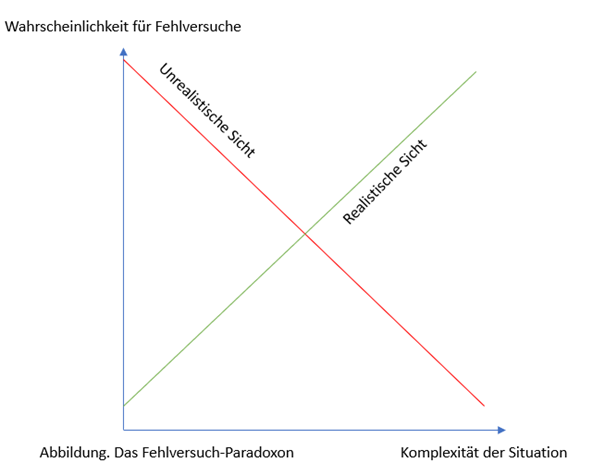
It's clear that the person assumes they should make fewer mistakes as the complexity increases. This view is understandable, as it stems from the desire to perform well and improve. Unfortunately, desires don't help us demonstrate our abilities (see my article "Is it a Wish or a Goal?" on this blog) . What are the consequences when the player enters the game with this unreflective expectation? After failed attempts, which are perfectly normal in this situation, the person will get upset and probably think, "That was bad. That shouldn't happen to me." The resulting frustration, along with increased tension, overthinking, and frantic decision-making, can lead to a further decline in performance. This occurs instead of accepting the failed attempts for what they are: normal and part of the process.
Let's assume the player has a normal number of missed shots in a junior match. And no, it's not zero. That's why the green line doesn't start at zero. Because no matter how easy a situation is, missed shots can always happen. That's simply probable and normal. Consequently, the number of missed shots in a two-set match might be around 25 (depending, of course, on many factors like my strength, my opponent's, the court, etc.). That's a different number than zero, isn't it? You can simply calculate how many strokes you have in a game and count your missed shots next time. Only once you exceed this guideline is it really justified to be annoyed. And yes, the same principle applies to an Alexander Zverev or an Eva Lys. Of course, I'm allowed to wish to play flawlessly. But wishful thinking shouldn't be the yardstick by which I judge my performance.
But back to the youth player. Let's assume he makes about 25 missed shots in a youth game. Consequently, an increase in this number in a more complex situation is simply realistic and to be expected. Therefore, a youth player should be aware before a game in a higher league that, in all likelihood, not everything will go as smoothly as in an easier environment.
The same phenomenon occurs in a wide variety of situations: selection training sessions, matches against stronger opponents, or even finals. In these situations, the mind often thinks, "Today I have to do everything perfectly." However, many factors come into play (e.g., the opponent's strength, league position, number of spectators) and make the situation more complex. Studies show that in top-level matches, teams and players statistically perform worse than average. And this is partly due to the complexity of the situation.
By becoming aware that my inner voice is always automatically active, and by checking before a training session or match whether I have realistic expectations of myself or my teammates. Because I might be transferring this phenomenon to my teammates and setting an unrealistic standard for them.
Furthermore, you should reflect on your own performance afterward. Perhaps you're only applying an unrealistic standard to yourself in retrospect. To support you in this, I'm happy to provide the worksheet "The 3-S Reflection" and hope that from today onward you won't fall so easily into the failed attempt paradox.
As a sports psychologist and psychotherapist, Sebastian supports various competitive and professional athletes from different sports in dealing with performance pressure, stress, and high demands. "Performing when conditions aren't optimal" and "be comfortable to feel uncomfortable" are his mottos. In addition to this work, he is a co-developer of the online program Ready2Perform ( www.ready2perform.de ), which aims to teach pressure management skills to a wider audience.

If you would like to learn more about monkeys and how to handle them, visit our online course at www.ready2perform.de . Here you will learn even more about monkeys, how they react in stressful situations, and how you can learn to interact with them.
"There is no passion to be found in shrinking back and settling for a life less than what one is capable of living." - Nelson Mandela
The online course "Ready2Perform" ( www.ready2perform.de ) aims to equip people with the necessary skills to master high-pressure and performance-oriented situations. It is designed for individuals who need or want to demonstrate their abilities in exams, performance tests, presentations, or critical moments such as emergencies or professional challenges. In such moments, when learned and practiced skills must be applied, people often fail not due to a lack of knowledge or ability, but rather due to the effects of pressure and a lack of coping skills. An elevated heart rate, racing thoughts, or strong feelings of insecurity can impair performance.

The "Ready2Perform" program, whose costs can be fully covered by health insurance, focuses on preventing these detrimental consequences and empowering people to perform at their best even under pressure. "Ready2Perform" offers more than just approaches for specific situations. The skills learned are designed to be used in everyday life, strengthening a person's resilience and psychological flexibility.
The online program "Ready2Perform" offers a mix of interactive instructional videos, practical experiments, and clear explanations to teach the necessary skills for working with pressure. The course consists of
So what are you waiting for? Do you want to become Ready2Perform?
A note from us: this article is not sponsored and we receive no commission whatsoever. We have personally experienced Sebastian's online course and recommend it wholeheartedly.












Register now and be the first to know about new tennis hotels and tennis camps as well as great promotions.
You can unsubscribe at any time. Please note our information on data protection .