
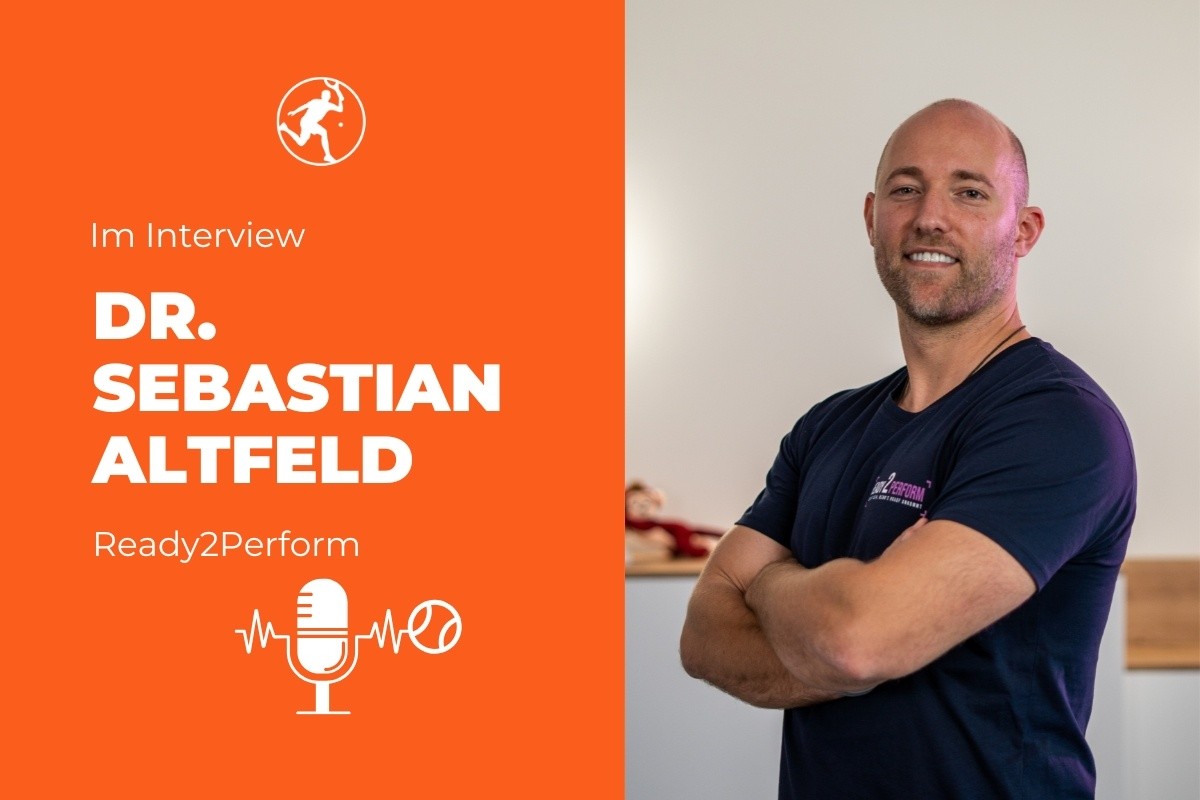
It is a great pleasure and honor for us to introduce you to Dr. Sebastian Altfeld, our new mental expert . Sebastian is a sports psychologist and psychotherapist who supports various competitive and professional athletes from different sports in dealing with performance pressure, stress, and high demands. "Performing when conditions aren't optimal" and "be comfortable to feel uncomfortable" are his mottos. In the interview, you'll learn more about Sebastian, typical stressful situations in tennis, and how you can cope with them. Sebastian is also the co-developer of the online program Ready2Perform , which we'll briefly introduce in the interview. We are convinced that this program will help you improve your skills in handling pressure, not just in tennis. We are very much looking forward to working with Sebastian on many more mental topics for you in the future. Because no matter your level: mental strength is so important!
As a sports psychologist and psychotherapist, Sebastian supports various competitive and professional athletes from different sports in dealing with performance pressure, stress, and high demands. "Performing when conditions aren't optimal" and "be comfortable to feel uncomfortable" are his mottos. In addition to this work, he is a co-developer of the online program Ready2Perform ( www.ready2perform.de ), which aims to teach pressure management skills to a wider audience.
Feel free to watch and listen to my interview with Sebastian as a video. Or you can read the interview below.
 I welcome Dr. Sebastian Altfeld, PhD in sports psychology. Sebastian, please briefly introduce yourself
Yes, absolutely. First of all, thank you for inviting me. I've been working as an applied sports psychologist in competitive and elite sports for over 10 years. Over the years, I've worked for various Olympic training centers, supporting athletes from a wide range of sports, including those preparing for the Olympics. I've also worked with several national teams. In addition, I provide individual coaching to various professional athletes, including tennis players. Typical topics include dealing with performance pressure, stress, and injuries – this is also one of my favorite topics, as I'm also a licensed psychotherapist, and that knowledge is invaluable in this area.
This means that I not only work on performance development, but also, through my therapeutic work, with athletes and coaches suffering from mental health issues. Here I encounter typical problems such as anxiety, eating disorders, and depression.
Another major focus of my work is with coaches. Besides lecturing in coaching courses for various sports, I specialize in burnout prevention. I wrote my doctoral thesis on burnout among full-time coaches and, as a result, I conduct various workshops on coach health and well-being. I do this, among other places, at the Coaches Academy in Cologne, where I regularly have A-level tennis coaches working towards their diplomas. In fact, I do a wide variety of things.
Before we delve a little deeper into the topic, I'd be personally interested to know: is there a personal story behind why this particular area interests you so much?Yes, actually. My life has been full of coincidences that have intertwined. After school, I didn't know what I wanted to do, so I did a voluntary social year in sports at a competitive basketball club. As you might guess, I also come from a basketball background myself, having been involved as both a player and a coach at a high level. So, I've always been involved with competitive sports.
My voluntary social year was a bit of a starting point for exactly that, as I encountered many challenging situations with players from disadvantaged backgrounds. After that year, I knew for sure: I absolutely wanted to work with children and young people in sports. Coincidentally, Jürgen Klinsmann, while he was a coach, made a high-profile public appearance for a sports psychologist at that very time. This sparked a thought in me: Wow, you can actually combine those – sports and psychology?
Psychology was very interesting to me, and from then on it was clear: I wanted to work in that field. And because I've always been involved in high-performance environments, it's kind of something that's in my DNA and something I simply enjoy.
Are there any "best-of" topics specifically from tennis players that they bring to you? I once worked with a German player on the tour, and she brought up a typical topic: 'Dealing with mistakes.' It was about how the margin for error that players give themselves is sometimes allowed to become very, very small. In the sense that they quickly get upset about something like, "Oh, I hit it into the net!" – and then dwell on it intensely. I called this the "failure paradox." The failure paradox is that people tend to think that the more important a situation is, the fewer mistakes they allow themselves. Let's illustrate this with an example: I'm about to play the most important match of my life – and in tennis, the most important match is usually the more complex one compared to the previous one, right? More spectators, a stronger opponent, perhaps a different level of importance in terms of consequences? And the more important a situation is (= the more complex a situation), does the probability of a mistake increase or decrease? What would you say?
Susanne: I'd say the probability increases?
Sebastian : Exactly, it actually increases. But what do people suddenly expect of themselves?
Susanne: That they make fewer mistakes. That today is the day of days.
Sebastian : Exactly. And that's the failed attempt paradox! People have an inverse expectation regarding the probability of errors. In a more complex situation, it's more likely that I won't have the perfect feel for the shot and the length won't be optimal. This increases the probability of unforced errors. Studies and statistics also show this: In the most important matches, players usually don't play their best tennis. Which is totally fine. Unless, of course, I expect it of myself. Then it can be the start of a negative spiral. The frustration over the "normal" mistake steals my focus for the next rally, which in turn increases the likelihood that it won't go in my favor. And so on…
I believe players need to understand this: the more important a situation is, the higher the likelihood of making a mistake. And I think that's a major lesson I've learned from all the tennis players I've had the privilege of coaching. I call it giving yourself more room to maneuver. Room to play. How can I play boldly if I'm constantly focused on avoiding mistakes? That's another paradox you have there.
Susanne : And the second typical topic?
Sebastian : I believe the second point goes hand in hand with the first: being in the moment. Being able to arrive in the moment, regardless of what has just happened. Be it the aforementioned missed attempt, but also how my opponent is playing, when the circumstances change, whether spectators are shouting or not. Dealing with these factors when they distract my attention from the actual task is, in my view, the second major issue in tennis.
Susanne : Yes, that's my own experience too. I think every tennis player can relate to that. Whether it's a local league player or a top-10 player, the situation is ultimately the same; only the tools and techniques might be different.
Sebastian : Exactly. The players have different tools at their disposal. The professional players have probably already dealt with the topic of the "mental game" more intensively.
You and your colleague Christian Luthardt have developed an online program called 'Ready to perform'. What's it all about?Christian Luthardt, the sports psychologist for Bayern Munich, and I developed this program because not everyone has access to the knowledge we impart to people in high-performance fields. The core of the online course is to empower people to access their full potential under pressure. Based on cutting-edge findings from sports psychology, cognitive behavioral therapy, and mindfulness-based approaches, the course offers a blend of interactive instructional videos, practical experiments, and clear explanations to help you learn how to manage pressure. Not everyone has access to a sports or performance psychologist, as we also call ourselves. Ready2Perform is therefore designed for situations where performance is paramount.
Is the course designed exclusively for the sports sector?Of course, we use sports examples, as these are easy to understand. However, the course is designed so that the content can be applied to any high-pressure situation. Therefore, the course is not only intended for performing at your best in competition, but also for final exams, emergency medical, police, or fire department operations, as well as important presentations at work. In short, it's relevant for any situation where people experience pressure and are prevented from reaching their full potential by the emotions that arise.
The course is even covered by health insurance Exactly. That makes us unique in Germany. The course is certified as a preventative health course and is therefore covered by health insurance. Depending on the health insurance company, up to 100% of the costs are covered!
Let's look at the course content. You mentioned beforehand that Ready2Perform is a high-pressure course, not a stressful one. What's the difference for you?Stress arises from everyday situations where demands exceed our available resources. A meeting that runs long, a long list of unanswered emails, or being late for an appointment due to traffic – these are the triggers we typically associate with stress. But stress doesn't necessarily mean pressure.
Pressure, on the other hand, is a situation where the outcome of our performance has serious consequences. It's not just the mere requirement, but the importance of the result that constitutes the pressure. The result could have significant repercussions. These can be social, such as being devalued or receiving negative press coverage. They can also be financial, involving prize money or, if the target isn't met, other forms of compensation. And then, of course, there can be physical consequences. This means there's a high risk of injury if I don't perform to my potential. This would be the case in extreme sports or, for example, during police or fire department operations. Distinguishing between these two concepts is crucial for us. Because when people understand that they are "only" in a stressful situation and not under pressure, this can already change their perspective and thus bring about a reduction in stress.
One thing is certain: Is a situation important to me? And is it perhaps even dangerous or threatening? Then feelings arise, and thoughts come to mind. A problem in high-pressure situations isn't a lack of knowledge or skills, but rather the ability to access and learn to manage the intense feelings and thoughts under pressure. It's not about remaining calm in these situations – unfortunately, this is a common misconception, in our view, that people think: 'I have to be calm. I have to be confident. I have to feel prepared when it's important.' What are the chances that I'll feel calm, confident, focused, and prepared at the most important moment of my life? Rather slim, right?
And if you ask tennis players, "How often in your life have you felt perfect—from start to finish in a match?"—they'll say, "Oh... once? Never?" Therefore, it's not about feeling good and striving for that state, but about being able to cope when I don't feel my best. And that's what we teach in this course. We impart the necessary skills and valuable knowledge to help me deal with it when I don't feel my best—to manage the thoughts and feelings that arise in those situations. That's far, far more important than feeling perfect—because that simply happens too rarely. It's more likely that something will happen that steals my focus or makes me feel insecure.
How exactly is your course structured?Christian and I feel it's extremely important that people get something out of the course. From a marketing perspective, it's actually the wrong approach to create obstacles. So, we clearly state in the booking process that the course requires effort. Because change always involves effort. We don't make empty promises, like some other online offerings unfortunately do. There's a course on "mental strength" that lasts 30 minutes, and another that promises the same results after a weekend. Naturally, I wonder how sustainable that is! For us, development also means time. Time for reflection and practice. We've incorporated these principles into the course. We want participants to get the maximum benefit from it.
We want to prevent people from rushing through the course without paying attention to the content. It took two years to develop because we really thought about what's important and what makes pedagogical sense. We simply don't want to give anyone an unrealistic idea like, "Hey, mentally strong in 3 days!" – that's unethical in our view. We're offering a serious program. The course, with all its content, exercises, and development tasks, lasts at least 6-8 weeks. But after that, participants are at a new level in terms of skills, mindset, and knowledge. After this course, people have learned things they didn't know before. I'm absolutely certain of that. But it takes time.
This course has 33 video lessons. Some videos are one minute long, others are 20 minutes. All are highly interactive. We try to explain psychological concepts in a non-psychological way and convey them practically through experiments. Ready2Perform consists of five modules. The first module is "Understanding"—so that people first understand: What actually happens in high-pressure situations? What happens physically? What happens to focus? And what are the triggers? In the second module, "Awareness," this new knowledge is applied to one's own high-pressure situations: "How does this actually affect me?" is explored.
The "Mindset" module then focuses on the question: What constitutes a good goal for a game? We previously demonstrated with the failed attempt paradox that people often set less helpful goals under pressure. We'll also be publishing an article on this topic soon on the blog. In that article, we'll explore whether a player sets a wish or a goal for a game. From my experience, I know that, unfortunately, it's too often wishes. Readers can read more about this in the article.
And then, in the fourth module, 'Training to Perform', we cover the skills for dealing with emerging feelings and thoughts. The final module, 'Prepare to Perform', brings everything together and imparts the final building blocks of knowledge on the topic of "preparation".
We analyzed with colleagues how many sessions they typically need with clients to impart this knowledge. The result was that the course comprises 16 individual sessions or 16 workshops with an expert. That's quite a lot.
How would you define the characteristics of a person who would benefit from this course as opposed to face-to-face consulting with you or a colleague, or in an on-site workshop?I think this course is only suitable for people who are able to learn in this way. The course does have many advantages. Besides the cost savings compared to individual sessions or workshops, which aren't covered by health insurance because they fall under coaching, the flexibility in terms of location and time is obviously a major plus. However, it requires that I'm able to independently set aside time to sit down and work through the material. And if I struggle with that, it's not the right program. If I need fixed appointments, then options like a workshop or one-on-one sessions are more helpful. So, it's really more for people who are able to learn independently instead of getting lost in other apps while sitting in front of a screen. That, in my opinion, is the key point.
At the same time, a certain level of mental maturity is required for the course. It presupposes that I possess the ability to reflect and apply the content to my own life. Therefore, I would say that the course makes more sense from the age of 15 onwards. Younger participants would be rather unusual, as younger children and teenagers do not yet possess the necessary reflective capacity to work through such a course for themselves.
In your opinion, how much does the mental aspect contribute to success in tennis? It depends a lot on the level. The higher I climb, the more optimized all the important areas are, such as athleticism, technique, strategy, and preparation. Preparation in the sense of travel, nutrition, recovery, and so on. The more optimized all these areas are, the more important the mental aspect becomes. That's logical in my view. If I'm playing tennis in the lower leagues, a certain level of athleticism helps me tremendously. I can run rings around everyone. Excellent stroke technique also helps if it allows me to make my opponent run, while I can simply stay put at the baseline. So, consequently: the lower I am, the more important other areas become—and the more I can initially compensate for mental shortcomings with other aspects. But at the same time, I believe that this mental aspect always plays a role. Because: I can have the best technique—if I can't translate it onto the court because I'm still preoccupied with the last shot, I can still stumble over my own mindset, even in the lower leagues.
I think it's a basic requirement that I can handle these kinds of situations. If you're asking about its importance: the higher I play, the more important the mental aspect becomes. At the same time, though, the mental aspect is, to a certain extent, a basic requirement for all areas. I think the Netflix documentary "Breaking Point" is fantastic in this regard. It follows the top 10 players in various tournaments. And I think it gives you a great insight into just how important the mind is in these areas and how much the mind can get in the way.
"There is no passion to be found in shrinking back and settling for a life less than what one is capable of living." - Nelson Mandela
The online course "Ready2Perform" ( www.ready2perform.de ) aims to equip people with the necessary skills to master high-pressure and performance-oriented situations. It is designed for individuals who need or want to demonstrate their abilities in exams, performance tests, presentations, or critical moments such as emergencies or professional challenges. In such moments, when learned and practiced skills must be applied, people often fail not due to a lack of knowledge or ability, but rather due to the effects of pressure and a lack of coping skills. An elevated heart rate, racing thoughts, or strong feelings of insecurity can impair performance.

The "Ready2Perform" program, whose costs can be fully covered by health insurance, focuses on preventing these detrimental consequences and empowering people to perform at their best even under pressure. "Ready2Perform" offers more than just approaches for specific situations. The skills learned are designed to be used in everyday life, strengthening a person's resilience and psychological flexibility.
The online program "Ready2Perform" offers a mix of interactive instructional videos, practical experiments, and clear explanations to teach the necessary skills for working with pressure. The course consists of
So what are you waiting for? Do you want to become Ready2Perform?
A note from us: this article is not sponsored and we receive no commission whatsoever. We have personally experienced Sebastian's online course and recommend it wholeheartedly.










Register now and be the first to know about new tennis hotels and tennis camps as well as great promotions.
You can unsubscribe at any time. Please note our information on data protection .